Loading [Contrib]/a11y/accessibility-menu.js
Haig, D. W., Rigaud, S., McCartain, E., Martini, R., Barros, I. S., Brisbout, L., Soares, J., & Nano, J. (2025). Triassic Massive Limestones Forming High Peaks and Mountain Ranges in Timor: Part 2: Eastern Timor-Leste. Journal of The Royal Society of Western Australia, 108. https:/​/​doi.org/​10.70880/​001c.154117
Download all (20)
  • Figure 1. SRTM image of Timor (compiled from NASA Shuttle Radar Topography Mission images) showing studied sites of Upper Triassic carbonate-platform facies limestones of the Bandeira Formation: 6, Daisoli River near Mount Urasou in the Turiscai region; 7, Mt. Lilu area; 8, Pualaca region; 9, Paitchau Range; 10, Tutuala area. Sites 1–5 were dealt with in Part 1 of this contribution (Haig et al. 2025).
  • Figure 2. Google-Earth image of the area northwest of Turiscai (Locality 6, Fig. 1) showing the sampled locality (samples 177–181; Appendix 3; at 8.7866°S, 125.6449°E) of the Bandeira Formation. [Image dated 10/8/2019]
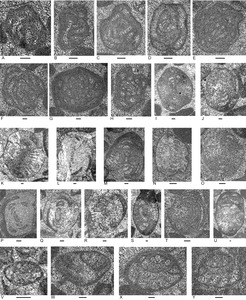
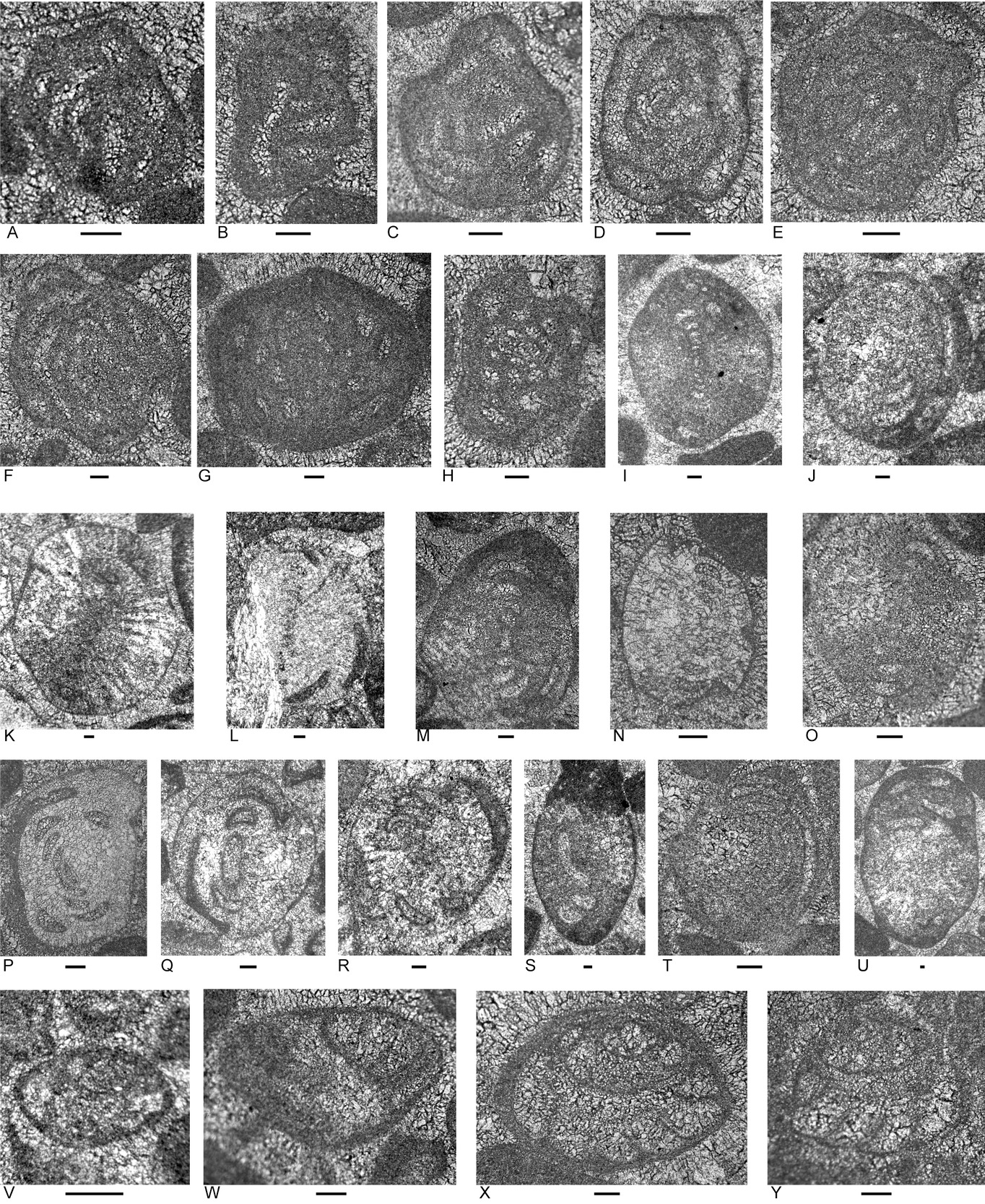
  • Figure 3. Foraminifers from the Bandeira Formation in the Turiscai area (Locality 6, Fig. 1). Bar scale = 0.1 mm.
  • Figure 4. Google-Earth image of the Mt Lilu area (Locality 7, Fig. 1) show­ing the positions of Bandeira Formation sample sites (yellow circles) on the limestone plateau (including Mt. Dilu) to the north-east of Mt Lilu. Geographic co-ordinates of samples are: 148, 8.5101°S, 125.9773°E; 149, 8.5097°S, 125.9787°E; 150, 8.5057°S, 125.9779°E, 151, 8.5051°S, 125.9747°E. [Image dated 8/10/ 2019]
  • Figure 5. Foraminifers from the Bandeira Formation in the Mt. Lilu area (Locality 7, Fig. 1). Bar scale = 0.1 mm.
  • Figure 6. Foraminifers from the Bandeira Formation in the Mt Lilu area (Locality 7, Fig. 1). Bar scale = 0.1 mm.
  • Figure 7. Google-Earth image of the Pualaca area (Locality 8, Fig. 1).
  • Figure 8. Foraminifers from the Bandeira Formation in Pualaca area (Locality 8, Fig. 1). Bar scale = 0.1 mm.
  • Figure 9. Foraminifers from the Bandeira Formation in Pualaca area (Locality 8, Fig. 1). Bar scale = 0.1 mm.
  • Figure 10. Localities 9 and 10 of the Bandeira Formation.
  • Figure 11. Locality 9: carbonate-cemented agglutinated/microgranular foraminifers from the Bandeira Formation in Iralalaru Hydropower Project, Boreholes 1 and 2, Paitchau Range (Locality 9, Figs. 1, 10). Bar scale = 0.1 mm.
  • Figure 12. Cornuspiroid, involutinid and polymorphine foraminifers from the Bandeira Formation in Iralalaru Hydropower Project, Boreholes 1 and 2, Paitchau Range (Locality 9, Fig. 1). Bar scale = 0.1 mm.
  • Figure 13. Robertinid foraminifers from the Bandeira Formation in Iralalaru Hydropower Project, Boreholes 1 and 2, Paitchau Range (Locality 9, Fig. 1). Bar scale = 0.1 mm.
  • Figure 14. Foraminifers from the Bandeira Formation in the Tutuala area (Locality 10, Fig. 1). Bar scale = 0.1 mm.
  • Figure 15. Foraminifers from the Bandeira Formation in the Tutuala area (Locality 10, Fig. 1). Bar scale = 0.1 mm.
  • Figure 16. Chronostratigraphic correlation of Triassic formations belonging to the East Gondwana Interior Rift Association in Timor-Leste.
  • Appendix 2
  • Appendix 3
  • Appendix 4
  • Appendix 5

Abstract

This is the second part of an extensive survey of outcrops of the Bandeira Formation (Triassic massive shallow-marine limestone successions) in Timor-Leste on the northwestern margin of the present-day Australian continent. During the Late Triassic (Carnian to within the Rhaetian), the limestones were deposited as carbonate platforms in the East Gondwana Interior Rift system. Foraminiferal assemblages in the studied limestones from the Turiscai, Lilu, Pualaca, Paitchau and Tutuala regions in eastern Timor-Leste belong mainly within the Norian and lower Rhaetian. The age determinations are at variance with some previous stratigraphic correlations of the limestone units in each area, and this together with a consistent set of adjacent stratigraphic formations, results in revision of the tectonostratigraphic affinities of these shallow-water Triassic carbonate deposits.

[Editor’s Note: Most of the content of this paper was originally archived in unpublished supplementary files to Haig, D.W., Rigaud, S., McCartain, E., Martini, R., Barros, I.S., Brisbout, L., Soares, & J. Nano, J. (2021a). Upper Triassic carbonate-platform facies, Timor-Leste: Foraminiferal indices and tectonostratigraphic association. Palaeogeography, Palaeoclimatology, Palaeoecology, 570, article 110362. https://doi.org/10.1016/j.palaeo.2021.110362. Some of the unpublished supplementary material is here published with permission from the Senior Copyright’s Specialist, Elsevier, in a pers. comm. to D.W. Haig dated 22 September 2023.]

INTRODUCTION

Following Haig et al.'s (2025) account of the Bandeira Formation in western Timor-Leste, limestone deposits from five regions (Sites 6–10; Fig. 1) in eastern Timor-Leste are described in this paper. The tectonostratigraphic affinity of the Bandeira Formation within the East Gondwana Interior Rift Association (Appendix 2) was discussed by Haig et al. (2021a; 2025). The stratigraphic setting, rock types, grain composition, and foraminiferal assemblages found in the limestones are outlined here together with the bases for age determinations and placement in the Bandeira Formation. Previous stratigraphic determinations for the outcrops are discussed. The materials and methods of the study were outlined in Haig et al. (2021a) and the localities of studied samples are detailed in Appendix 3.

Figure 1
Figure 1.SRTM image of Timor (compiled from NASA Shuttle Radar Topography Mission images) showing studied sites of Upper Triassic carbonate-platform facies limestones of the Bandeira Formation: 6, Daisoli River near Mount Urasou in the Turiscai region; 7, Mt. Lilu area; 8, Pualaca region; 9, Paitchau Range; 10, Tutuala area. Sites 1–5 were dealt with in Part 1 of this contribution (Haig et al. 2025).

Carbonate-platform facies of the Lower Jurassic Perdido Group, often confused with the Bandeira Formation or with younger limestone units, are present at localities labelled J1–J7 (see Haig et al. 2021b). Lower right: present-day tectonic setting of Timor.

Locality 6: Turiscai region

Rock types sampled

Five limestone samples from Locality 6 on the Daisoli River, about 8 km north-west of Turiscai, were examined (Figs. 2, 3; Appendices 2, 3). This material includes three coarse grainstone samples and two samples of calcimicrobe floatstone with a peloidal packstone to wackestone matrix. Clast types that are present in all samples include peloids, porostromate calcimicrobes, involutinid and robertinid (mainly duostominine) foraminifers, gastropods and indeterminant echinoderm debris. Other grains present include possible dasycladacean algae, Microtubus encrustations, carbonate-cemented agglutinated/microgranular foraminifers, calcareous sponges, punctate brachiopods, recrystallized bivalve fragments and fragments with prismatic microstructure, and echinoid spines. In the presence of involutinid and duostominine foraminifers, calcimicrobes, echinoid debris, calcareous sponges, and punctate brachiopods, and possible dasycladacean algae, the rock types resemble those of Unit 1 of the type section of the Bandeira Formation (Haig et al. 2025, locality 1). The duostominines are confined to the Triassic.

Foraminifera

Foraminifers (Fig. 3; Appendix 4) are represented by few species. The tests are partly recrystallized and belong mainly to involutinids and duostominines. Genera include the involutinids Aulotortus (Fig. 3I–Q,S,T) and Parvalamella (Fig. 3R,U), the duostominines Cassianopapillaria (Fig. 3W) and Duostomina (Fig. 3X,Y) and micritized morphotypes that may be either the carbonate-cemented Gandinella or the involutinid Parvalamella (Fig. 3C–H).

Age

The assemblage contains none of the involutinid and duostominine species collectively indicative of the Carnian that are present in Unit 1 at the type locality of the Bandeira Formation (Haig et al. 2021a, 2025). Based on stratigraphic ranges outlined in Appendix 5, Aulotortus sinuosus indicates a broad correlation within the Anisian–Rhaetian and Parvalamella friedii within the Ladinian–Rhaetian. As in samples from the Loelaco Fatu and the Iralalaru #1 borehole section, an un-named morphotype is present that is close to Aulotortus sinuosus but with “strengthenings” (see Rigaud et al. 2013) in the final whorls. Similar morphotypes are known from the Rhaetian of Italy (de Castro 1990) and Seram (Martini et al. 2004). The age here is within the Norian to Rhaetian interval, possibly Rhaetian.

A satellite view of a mountain range AI-generated content may be incorrect.
Figure 2.Google-Earth image of the area northwest of Turiscai (Locality 6, Fig. 1) showing the sampled locality (samples 177–181; Appendix 3; at 8.7866°S, 125.6449°E) of the Bandeira Formation. [Image dated 10/8/2019]
Figure 3
Figure 3.Foraminifers from the Bandeira Formation in the Turiscai area (Locality 6, Fig. 1). Bar scale = 0.1 mm.

A, B, Indeterminant species with glomospire coiling; from Sample 178. C–H, Micritic tests that show coiling similar to Pilammina kuthani (Salaj, in Salaj et al. 1967, holotype their pl. 3, fig. 5) or Glomospirella capellinii Ciarapica and Zaninetti (1984, holotype their 2, fig. 5), different from Piliammina sulawesiana Martini et al. (1995, holotype their pl.1, fig. 1) in looser and fewer initial coils, but may have been diagenetically micritized with some tests showing faint indications of lamellae and perforations suggesting an assignment to Parvalamella spp. ; C, D and H, from Sample 178, E and F from Sample 177, G from 179. I–Q, S, T, Aulotortus sinuosus Weynschenk 1956; note variable preservation even within one sample; J, M, N, O, P may display strengthenings in the last few whorls, as in the Rhaetian species described by de Castro (1990) from Salemo, Italy. I and N from Sample 179, J, L, M, T from Sample 177, K, O–Q and S from Sample 178. R, U, Parvalamella friedli (Kristan-Tollmann 1962); R from Sample 177, U from Sample 178. V, Indeterminant probable Cassianopapillariinae, from Sample 177. W, Cassianopapillaria aff. laghii (di Bari and Rettori 1996); larger size that typical C. laghii; from Sample 178. X, Y, Indeterminant Duostominina; X from Sample 179, Y from Sample 181.

Previous stratigraphic designation and stratigraphic association

Wanner (1956) noted a Weber locality on the track to Turiscai at about 9 km south-east of Remexio at what he called Fatu Rilau near Kaimuk. The position of this site is uncertain as names change through time. The locality included a reef limestone with corals and solenoporacean algae like the Upper Triassic fauna at Pualaca. It is probable that the Bandeira Formation is present at various localities in this area. This region (including Locality 6) was mapped as part of the “Ofiolitos e xistos cristalines (predominantemente paleozóicos)” by Grunau (1957) whereas Gageonnet and Lemoine (1958) included it in the Mesozoic of the “Autochone”. On Audley-Charles’s (1968) map, Locality 6 lies near the northern limit of an area mapped as Jurassic Wailuli Formation, and south of the Permian Maubisse Formation mapped along the “Ramelau Range”. Unpublished reconnaissance work by E. McCartain along the Daisoli River close to Locality 6, found outcrops of the Cribas Group (siliciclastic-volcaniclastic Permian facies).

Locality 7: Mt Lilu region

Rock types sampled

Samples of the Bandeira Formation were examined from four localities in a topographically high block close to Mt Dilu 4.5 km west of Manatuto town (Figs. 1, 4; Appendix 3). All samples are rudstone and have a grain assemblage (Appendix 4) like that in Units 1 and 5 at the formation’s type locality (Haig et al. 2025, locality 1). Micritic clasts, involutinid foraminifers, robertinid foraminifers (mainly duostominines), and recrystallized bivalve fragments are present in each sample. Other bioclasts of variable distribution are aggregate carbonate grains, solenoporacean algae, dasyclad algae, Microtubus encrustations, carbonate-cemented agglutinated/microgranular foraminifers and nodosariids.

Figure 4
Figure 4.Google-Earth image of the Mt Lilu area (Locality 7, Fig. 1) show­ing the positions of Bandeira Formation sample sites (yellow circles) on the limestone plateau (including Mt. Dilu) to the north-east of Mt Lilu. Geographic co-ordinates of samples are: 148, 8.5101°S, 125.9773°E; 149, 8.5097°S, 125.9787°E; 150, 8.5057°S, 125.9779°E, 151, 8.5051°S, 125.9747°E. [Image dated 8/10/ 2019]
A collage of images of cells AI-generated content may be incorrect.
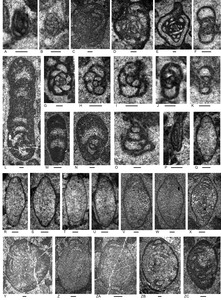
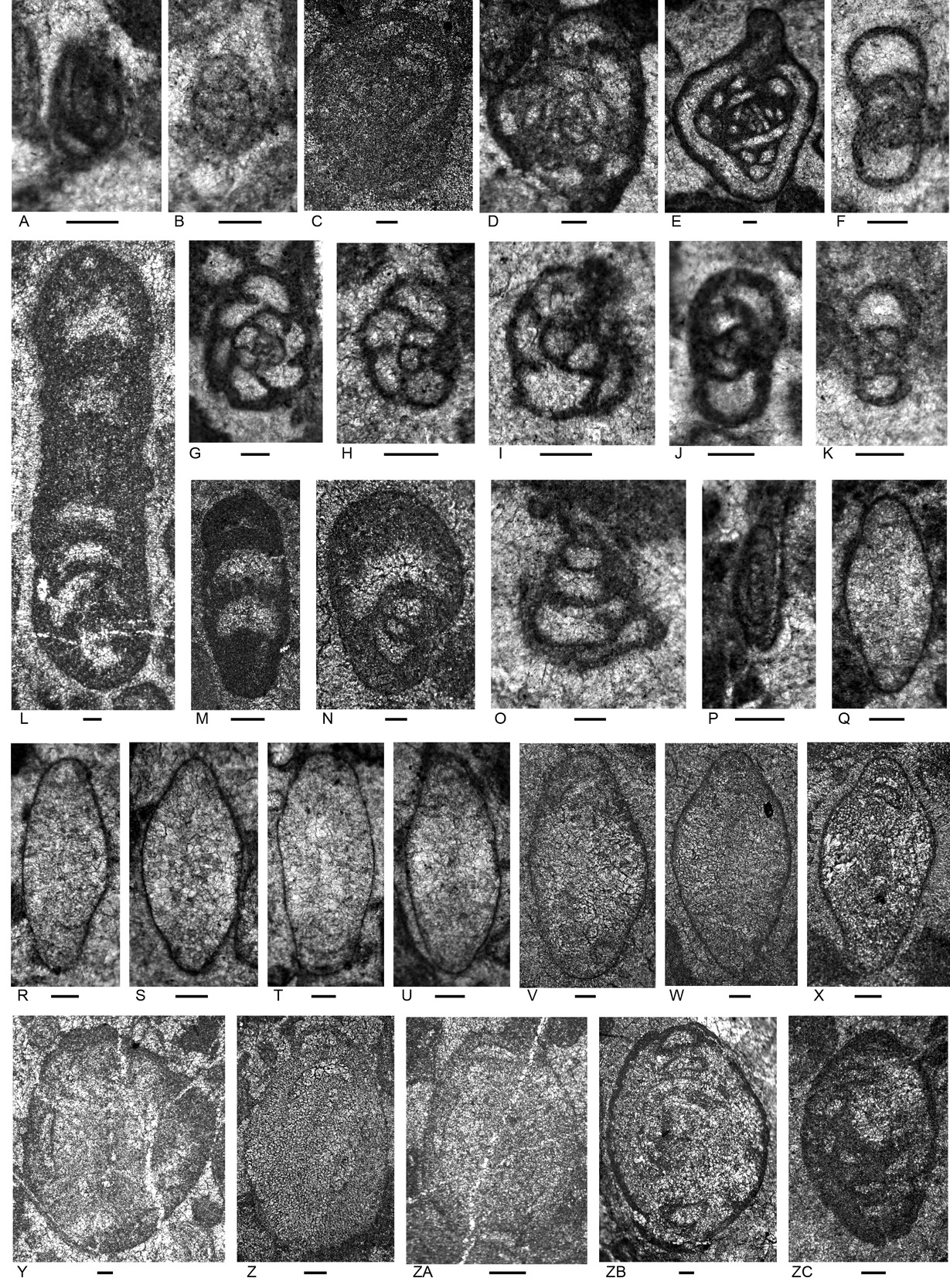
Figure 5.Foraminifers from the Bandeira Formation in the Mt. Lilu area (Locality 7, Fig. 1). Bar scale = 0.1 mm.

A, Indeterminant species with glomospire coiling, A from Sample 151. B, Indeterminant aulotortid with micritized wall, from Sample 148. C, D, Morphotypes similar in coiling to Gandinella capellinii (Ciarapica and Zaninetti 1984), but tests may be micritized; C shows faint remnants of lamellae and perforations and is probably Parvalamella sp., D may also belong here; C from Sample 151, D from Sample 150. E, ? Gandinella gemerica (Salaj 1969), from Sample 150. F, H–K, Endoteba ex gr. obturata (Brönnimann and Zaninetti 1972) following Vachard et al. (1994), F and K from Sample 148, H and 1 from Sample 150, J from Sample 151. G, Endotriadella aff. wirzi (Koehn-Zaninetti 1969); juvenile test; note aerial foramen in last septum; from Sample 151. L, Endotebanella robusta (Salaj 1978), from Sample 151. M, Indeterminant carbonate-cemented agglutinated species; multiple foramina appear to be present along the second-last septa exposed in this section; from Sample 148. N,Everticyclammina” cf. simplex (Urosevic 1981), from Sample 149. O, Duotaxis sp., from Sample 148. P, indeterminant; probably an ophthalmidiid, from Sample 150. Q–X, Aulotortus communis (Kristan 1957); Q–U from Sample 150, V and W from Sample149, X from Sam­ple 151. Y, ? Aulotortus sinuosus Weynschenk 1956, from Sample 151. ZB–ZC, ?Z, ?ZA, Parvalamella friedli (Kristan-Tollmann 1962); Z and ZA from Sample 151; ZB and ZC from Sample 148.

A collage of images of cells AI-generated content may be incorrect.
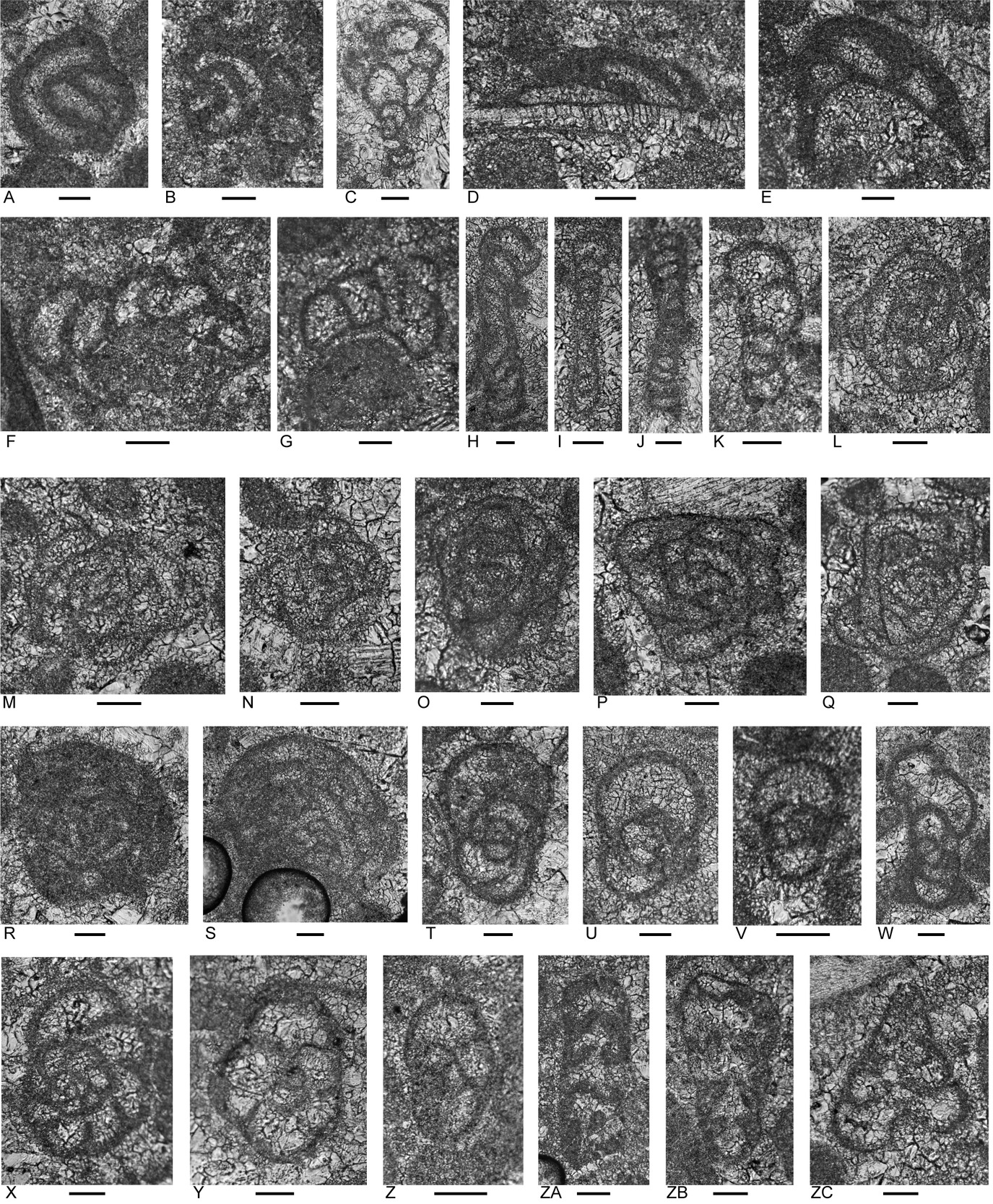
Figure 6.Foraminifers from the Bandeira Formation in the Mt Lilu area (Locality 7, Fig. 1). Bar scale = 0.1 mm.

A–C, if these tests were originally aragonitic (and subsequently micriticized) they belong to Falsoreinholdella sp.; however, if originally carbonate-cemented finely agglutinated/microgranular then they would be best placed in “Trochamminajaunensis Brönnimann and Page 1966, but not in the organic-cemented agglutinated Trochammina Parker and Jones 1859 (see explanation of Fig. 3) and not related to the apparently organic-cemented siliceous agglutinated Trochammina cf. “Trochamminajaunensis of Gale et al. (2022). A and B from Sample 148, C from Sample 150. D–V, Indeterminant duostominines; D–F, J–L may possess papillose lamellae and represent Cassianopapillariinae. D, E, G–I, K, N, P, R, S–V from Sample 148; F, J, L, Q from Sample 151; M, O from Sample 149.

Foraminifera

A low diversity foraminiferal assemblage of 10 species (Figs. 5, 6; Appendix 4) is present in the studied samples. Genera include the carbonate-cemented agglutinated/microgranular Duotaxis, Endoteba, Endotebanella, “Everticyclammina”, and possible Gandinella; involutinids Aulotortus and Parvalamella, and duostominines Duostomina and Cassianopapillaria.

Age

The foraminiferal assemblage is characteristic of the Triassic based on the general taxonomic composition and the ranges of species (Appendix 5). Based on the presence of Aulotortus communis (Fig. 5Q–X) the age is within the Norian to Rhaetian interval. The position of this species in the evolutionary succession of involutinids was established by Koehn-Zaninetti (1969, fig. 21) and Zaninetti (1976) although see a different version by Piller (1978) involving species synonymies and updated generic attributions. The species was originally described as Angulodiscus communis Kristan 1957, type species of Angulodiscus Kristan 1957 which we regard as falling within the broad spectrum of Aulotortus. Other foraminifers identified to species or species-group level provide broader age limits based on presently known stratigraphic ranges (Appendix 5): Endoteba obturata (ex. gr. morphotypes, Fig. 5F, H–K), Anisian–Norian; Endotebanella robusta (Fig. 5L), middle Anisian; Endotriadella wirzi (“aff.” morphotype, Fig. 5G), uppermost Olenekian–Carnian; “Everticyclammina” cf. simplex (Fig. 5N), Carnian. The presence of these species associated here with A. communis suggests that some aspects of their known stratigraphic ranges require revision.

Previous stratigraphic designation and stratigraphic association

A thrust block of Maubisse Formation surrounded by Wailuli Formation was mapped by Audley Charles (1968) in the Mt Lilu region, partly following the interpretations of Grunau (1957), who mapped the region as “Triásico (perto de Pualaca também Jurássico)” and Gageonnet and Lemoine (1958), who mapped limestone blocks as “Permien charrié (série de Maubisse, série de Sonnebait)”. Nakazawa and Bando (1968) produced a sketch map of the Mt Lilu area and found “Fatu limestones” dated as Triassic and possibly Permian, as well as “flysch-like” interbedded sandstone and shale of “Mesozoic (Triassic?)” age. The limestones included a reddish brown ammonoid-rich limestone and a grey-brown massive limestone dated as Early Triassic by ammonoids and conodonts; and a dark grey limestone, attributed to the Ladinian or lower Carnian, containing abundant Daonella bivalves and conodonts (Nakazawa and Bando 1968). The conodonts were also taxonomically catalogued by Nogami (1968). Grady and Berry (1977) mapped the limestone as Permian. More detailed mapping of the area by Berry et al. (1984, their fig. 2) established the “Lilu Beds” for “red and white limestone, shale with minor arkosic sandstone, and altered basalt and shale with minor limestone and graywacke”. They concluded that this unit belonged to the “upper Lower and Middle Triassic possibly ranging down to the Permian”. They also noted a white gastropod limestone and a thin-bedded white limestone. Surrounding their Lilu Beds they mapped a unit of shale with minor arkosic sandstone interbeds that they called the “Condar Beds”. Haig and McCartain (2007, their fig. 7b) demonstrated that a thin-bedded carbonate pelagite outcropping on the western part of the summit area on Mt Lilu belonged to the Turonian (Upper Cretaceous).

In more recent unpublished studies of this area, we have recognized the Permian Maubisse Group including Colaniella beds of Wuchiapingian (Late Permian) age. A structurally conformable contact has been identified between Triassic ammonoid-rich limestone that is stratigraphically condensed (probably as old as latest Griesbachian, lower Induan; designated the Lilu facies by McCartain et al. 2024) and the underlying Permian Maubisse Group. Shallow-water limestone of the Bandeira Formation has been found structurally above (and possibly progradational from) the Lower to Middle Triassic Lilu facies in this area. Surrounding the limestone outcrops is the Babulu Group (equivalent to the Condar Beds of Berry et al. 1984). These units collectively belong within the East Gondwana Interior Rift Association and the carbonate-pelagite on the summit of Mt Lilu described by Haig and McCartain (2007) belongs to the post-breakup Timor–Scott Plateau Association (see Appendix 2).

Locality 8: Pualaca region

Rock types sampled

Three rudstone samples of Bandeira Formation were studied from this area (Figs. 1, 7; Appendices 2, 3). They come from two slumped blocks of massive limestone in the Mota Mutin. Clasts, typical of limestones in the formation, include micritized fragments, porostromate calcimicrobes, solenoporacean algae, robertinid (duostominine) foraminifers, calcareous sponges, gastropods, and echinoid spines. Other grain types include oncoids, reworked shallow-marine limestone clasts, Microtubus encrustations, carbonate-cemented agglutinated and involutinid foraminifers, possible corals, encrusting bryozoans, impunctate and punctate brachiopods, recrystallized bivalve fragments and fragments with prismatic microstructure, indeterminant echinoderm debris, and ostracods.

Foraminifera

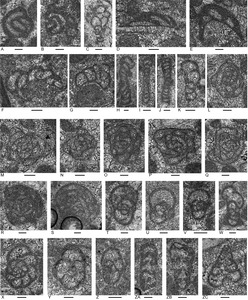
A low diversity foraminiferal assemblage, typical of the Triassic, has been recognized in the samples (Figs. 8, 9; Appendix 4) belonging to the following genera: carbonate-cemented agglutinated/microgranular Duotaxis (but for “Duotaxis nanus” considered uncertain by Falzoni et al. 2025), ?Endoteba, Endotebanella, “Everticyclammina”; involutinids Aulotortus; and duostominines, ?Cassianopapillaria, Diplotremina, and Duostomina.

A map of the egira mountains AI-generated content may be incorrect.
Figure 7.Google-Earth image of the Pualaca area (Locality 8, Fig. 1).

Bandeira Formation sample sites of the present study are shown by yellow circles. Positions of Fatu Laculequi (A on image) and Fatu Naruc (B) are shown. The tentative boundary between the East Gondwana Interior Rift Association (EGIRA) and the Overthrust Terrane Association (OTA) is shown. Geographic co-ordinates of studied samples are: 152, 8.8031°S, 125.9514°E; 153, 8.8067°S, 125.9516°E. The precise locality of sample 154 close to these samples in this region is unknown. [Image dated 7/9/2019]

A collage of images of a human body AI-generated content may be incorrect.
Figure 8.Foraminifers from the Bandeira Formation in Pualaca area (Locality 8, Fig. 1). Bar scale = 0.1 mm.

A, D, K, M, N, P–R, ?L, ?O,Everticyclammina” cf. simplex (Urosevic 1981), including morphotypes transi­tional from Endotebanella, K, L, N–R from Sample 153, M from Sample 154. B, C, E, F, I, J, Endotebanella indeterminant, oblique longitudinal sections that miss the initial coil. A, C, D, F, J from Sample 153, B from Sample 154, E and I from Sample 152; G–H, Endotebanella cf. robusta (Salaj 1978), from Sample 153. S, Endotebanella sp., from Sample 153. T, Indeterminant endothyroid, from Sample 154. U, V, Indeterminant high trochospiral morphotypes; the presence of an umbilical canal cannot be con­firmed; possibly Duotaxis nanus (Kristan-Tollmann 1964), species generic attribution considered uncertain by Falzoni et al. (2025) because of poor preservation of type specimen; from Sample 152. W–Y, Indeterminant; probably ophthalmidiids in transverse sections; from Sample 152. Z–ZB, Aulotortus sinuosus Weynschenk 1956; Z and ZA from Sample 154, ZB from Sample 153. ZC, Astacolus sp., from Sample 152.

A collage of images of a cell AI-generated content may be incorrect.
Figure 9.Foraminifers from the Bandeira Formation in Pualaca area (Locality 8, Fig. 1). Bar scale = 0.1 mm.

All sections from Sample 153, except M, O and T from Sample 152. A–F, Diplotremina altoconica Kristan-Tollmann 1973. G, Probably Cassianopapillaria sp. H–T, Indeterminant Duostominina; preservation (micritization) and/or section cut are unsuitable for con­fident determinations. **
Age**

Diplotremina altoconica (Fig. 9A–F; Appendix 4), which ranges from Carnian to Norian (Appendix 5), is present. The assemblage lacks species of Lamelliconus and Prorakusia as well as Parvalamella? praegaschei common in Carnian Unit 1 of the type Bandeira Formation (Haig et al. 2025). Although Aulotortus sinuosus (Fig. 8Z–ZB; Appendix 4) is present, the Norian–Rhaetian Aulotortus communis is absent distinguishing the observed Pualaca assemblages from those at localities 3, 4, 7, 9-2, 9-3, and 10 (Appendix 4) and from localities 3 and 4 of Haig et al. (2025). The age is probably early Norian or late Carnian.

Previous stratigraphic designation and stratigraphic association

The area of dismembered formations around Pualaca (Locality 8, Figs. 1, 7) has not been detailed in published reliable maps. Charlton et al. (2009) summarized previous work in the region. Triassic rocks in this area were found initially by Hirschi (1907) who observed thin-bedded dark limestones and interbedded mudstones that contained halobiid bivalves, which are now placed into basinal Triassic facies (either Babulu or Aitutu formations; see Appendix 2). He also described outcrops of light-grey thick-bedded to massive crystalline limestone that in places contain corals and suggested a possible Triassic or young Paleozoic age. The Jurassic strata that Hirschi (1907) recognized are now placed within the Wailuli Formation; and the young Paleozoic reddish-brown limestone with the trilobite Phillipsia is placed within the Permian Maubisse Group.

Wanner (1956) reviewed palaeontological work done on samples collected by Friedrich Weber during 1910–1911 around Pualaca, particularly the work on corals and algae by Vinassa de Regny (1915) and on molluscs and brachiopods by Krumbeck (1921). He noted differences in age determinations by these authors. The two main localities with Upper Triassic coralline limestones were Fatu Laculequi (A on Fig. 7) and Fatu Naruc (B on Fig. 7). On the bases of brachiopods, Krumbeck (1921) suggested that the Fatu Laculequi limestone belonged probably to the upper Carnian, whereas Vinassa de Regny (1915) found that the corals in this fatu and in Fatu Naruc were known, at generic level, from the Zlambach Beds in Austria, now considered Rhaetian. Yamagiwa (1963) also described the corals from Fatu Laculequi. As well as other localities of the Fatu Limestone facies, Wanner (1956) noted in this area many Weber localities of basinal mud facies with Ladinian to Norian halobiid bivalve faunas.

Grunau (1957) mapped a large area in the Pualaca region as “Complexo de Corbertura” with “Ofiolitos e xistos cristalines” and “Pérmico” and “Calcários de Fato de idade indeterminada em parte triásicos”. According to his map, east of Pualaca was “Complexo Autoctono” with “Triásico (perto de Pualaca também Jurássico)”. He noted that Mt Bissori was a diabase and Permian in age because of its close association with Fenestella limestone. He also suggested that Mt Calaun and Mt Fehuc (see Fig. 7) were unfossiliferous, in terms of macrofossils.

Gageonnet and Lemoine (1958) mapped “Calcaires Fatu (Complexe Charrie)” as a narrow ovoid area including ?Bissori, Calaun and Fehuc mountains (Fig. 7) west of Pualaca and trending south; with a small area of “Roches métamorphiques et éruptives (Complexe Charrié)” at the southern margin, near Soibada. This was designated by Audley-Charles (1968) as the Lower Miocene Cablac Limestone with the mainly volcanic Barique Formation on the southern margin, and the area surrounding it and to the east of Pualaca represented by the “Upper Triassic–Middle Jurassic” Wailuli Formation. Audley-Charles (1968) did not differentiate the Upper Triassic coralline limestones that earlier workers had described. Charlton et al. (2009) referred to these as the “Pualaca facies”.

Field observations and sampling by us (including McCartain, 2014*, 2024; Haig et al. 2021b; Barros et al., 2025) confirms that two main tectonostratigraphic associations are present in the region (Fig. 7) although the boundary between these can only be tentatively positioned before detailed mapping takes place. In the EGIRA area (Fig. 7), Mt Lafulolau, Mt Bissori and associated limestone (see Nogami, 1963; Nakazawa and Bando, 1968) and limestone in an area immediately south of Mt Aubean are Permian (Maubisse Group). Our limited sampling at the side of Mt Aubean suggests that the limestones here are of Triassic shallow-marine facies, but foraminifers have not been observed. Basinal mud facies of the Middle and Late Triassic (Babulu and Aitutu formations) are present on the western and eastern slopes of Mt. Nono Lulik and around Pualaca and on the lower western-facing slopes of the Mota Mutin valley (see also Nogami, 1968; Nakazawa and Bando, 1968). The Upper Triassic Bandeira Formation is present in small outcrops on the eastern side of Nono Lulik to the Mutin River. East of the Manatuto–Natarbora Road, Lower Jurassic shales of the Wailuli Group outcrop. The Bandeira Formation in the Pualaca area is associated with the Permian shallow-water limestones, and the Triassic and the Lower Jurassic basinal mud deposits in EGIRA (see Appendix 2) as Wanner (1956) suspected.

In the Mota Samora that flows through a deep gorge between the Calaun and Fehuc mountains, large boulders of oncolitic limestone are present containing a Lower Jurassic foraminiferal assemblage including the complex carbonate-cemented agglutinated foraminifer Lituosepta (Haig et al. 2021b) A sample of oolitic limestone on the crest of Mt Fehuc at its southern side includes a foraminiferal assemblage with abundant Siphovalvulina, ?Nautiloculina, and Textulariopsis, and may be upper Lower Jurassic or Middle Jurassic. These limestone facies belong within the Perdido Group and are associated here with mafic volcanic and metamorphic rocks as indicated by Hirschi (1907), Gageonnet and Lemoine (1958) and Audley-Charles (1968). This is typical of OTA. We are uncertain about the age or tectonostratigraphic affinity of the Mt Calaun rocks (Fig. 7).

Locality 9: Iralalaru Boreholes, Paitchau Range

Two continuously cored shallow boreholes, closely spaced, in the Paitchau Range (Fig.10) have been examined in this study. These were drilled in 2006 by the then Ministry of Natural Resources, Minerals and Energy Policy with assistance and funding from the Norwegian Water Resources and Energy Directorate (2006*). The aim was to assess rock quality and possible karstic features in the crystalline limestone present in the range (Geotechnik Pty Ltd. 2006*).

No lithological log or completion report on the boreholes have been available for the present study and may not have been made. We have no information as to the younging direction of the cored section (i.e. whether the strata have been overturned). The core (Fig. 10C, D), examined in 2016 when it was housed at the Electricity Commission building in Dili, showed large gaps with broken core pieces probably due to numerous cavities within the rock. The two boreholes, drilled in proximity, provide intermittent coverage down to about 170 m below surface. Because of the steep dip of strata, the stratigraphic thickness traversed was much less. In the drilling log, prepared by Geotechnik Pty Ltd. (2006*), the boreholes were divided into three units, of which only the upper two were cored (Fig. 10A).

For this study, the taking of core material for study was prohibited. Cutting the core transversely at regular intervals and making acetate peels from the slabbed surfaces was permitted. Eighty-seven peels were prepared on site (Appendix 3). The distributions of grain types and foraminiferal species are charted in Appendix 4, and the representative foraminifers are illustrated in Figs. 11–13. In the discussion below, the cored sections are referred to as (1) the upper massive limestone unit (to about 63 m depth below surface), and (2) the middle unit (from about 62 m to 167 m below surface).

A close-up of a diagram AI-generated content may be incorrect.
Figure 10.Localities 9 and 10 of the Bandeira Formation.

A, Log of Iralalaru Hydropower Project Boreholes #1 and # 2 in the Paitchau Range (Locality 9), with the positions of the sampled core segments. B, Google Earth image showing the positions of Localities 9 and 10 with respect to the Paitchau Range and Tutuala [image dated 2019]. C, D, examples of core sampled from the boreholes (note sections of rubble indicating the cavernous nature of the limestone resulting in incomplete recovery). The core was not cut vertically, as this was not allowed by the Electricity Commission of Timor-Les­te. Acetate peels were taken from transverse cuts. Locality geographic co-ordinates are Locality 9, Iralalaru Hydropower Project Boreholes 1 and 2, 8.4914°S, 127.1749°E; and Locality 10, Tutuala area, 8.3915°S, 127.2576°E.

Upper massive limestone unit

Rock types sampled

In the upper massive limestone (down to about 63 m in the boreholes; Fig. 10A), rudstone dominates with grainstone and wackestone represented in very few samples (Appendices 2, 3). Almost all samples contain abundant to common micritic clasts ranging from peloid to nodule size. Among the biogenic components, the most persistent grain types (present in at least half of the samples and listed here in a decreasing order of persistence) are porostromate calcimicrobes, involutinid foraminifers, recrystallized bivalve fragments, robertinid foraminifers (mainly duostominines), gastropods, carbonate-cemented agglutinated or microgranular foraminifers and ostracods. Other types present in fewer samples are reworked shallow-marine limestone clasts, solenoporacean algae, dasycladacean algae, Microtubus encrustations, Tubiphytes, porcelaneous foraminifers, very rare nodosariid, vaginulinid and polymorphinid foraminifers, calcareous sponges, very rare, isolated sponge spicules, very rare possible bryozoans, impunctate brachiopods, and echinoderm debris including echinoid spines. This grain assemblage is typical of the Bandeira Formation elsewhere and with the distinctive involutinid and duostominine foraminifers is typically Triassic.

Foraminifera

Foraminifers from the upper massive limestone include a diverse assemblage although sporadic in distribution (Appendix 4). Genera include the carbonate-cemented agglutinated/microgranular Duotaxis, Endoteba, Endotriadella, “Everticyclammina”, Gandinella, Hoyenella, Rectoglomospira, and “Tolypammina”; involutinids ?Aulosina, Aulotortus, Parvalamella, and Triasina; the polymorphinid Eoguttulina, and duostominines Diplotremina and Duostomina. This assemblage is typically Triassic.

A collage of images of a person's face AI-generated content may be incorrect.
Figure 11.Locality 9: carbonate-cemented agglutinated/microgranular foraminifers from the Bandeira Formation in Iralalaru Hydropower Project, Boreholes 1 and 2, Paitchau Range (Locality 9, Figs. 1, 10). Bar scale = 0.1 mm.

A–E, Indeterminant species with glomospire coiling; possibly related to Rectoglomospira Trifonova 1978; A and C from Sample 48, B from Sample 49, D from Sample 85, E from Sample 51. F, Indeterminant morphotype with irregular coiling, from Sample 85. G, H, Hoyenella vulgaris (Ho 1959), from Sample 84; although this Glomospirella-type species has fewer whorls than in the type species, Hoyenella sinensis (Ho 1959), it is placed in Hoyenella because of its carbonate microgranular rather than organic-cemented siliceous agglutinated wall (characteristic of the type species of Glomospirella). I, Gandinella sp, from Sample 79; differs from other Gandinella observed here by a tight “twisted” initial stage followed by a few whorls with oscillatory coiling, and no planispiral coiling at any stage during growth. J, Gandinella gemerica (Salaj 1969), from Sample 84; differs from other species of Gandinella in having an initial irregular to streptospiral coil occupying about 0.6 of the test diameter, and a later stage that be­comes almost planispiral. ?K, L–M, Gandinella capellinii (Ciarapica and Zaninetti 1984), from Sample 84; distinguished by having a tight initial stage with oscillatory coiling followed by a looser final stage also with oscillatory coiling. N, ? Parvalamella friedli (Kristan-Tollmann 1962), from Sample 53; this test seems to have remnants of lamellar microstructure and perforations in the wall. Micritization during diagenesis makes the distinc­tion between Parvalamella and Gandinella difficult. O, P, Endoteba sp., from Sample 48. Q, Endotriadella aff. wirzi (Koehn-Zaninetti 1969), from Sample 69; initial coil partly obscured. R, T, “Everticyclamminaalveolatus (Salaj, Borza and Samuel 1983), from Sample 49. These morphotypes are transitional from Endotebanella Vachard et al. 1994 (perhaps from Endothyranella robusta Salaj, 1978) to “Everticyclammina” as interpreted by Fugagnoli (2000) for the Lower Jurassic Everticyclammina praevir­guliana Fugagnoli, 2000. The species illustrated here is placed within “Everticyclammina” because of the few irregular invaginations on the inner surface of the wall of the final chambers and its relationship to the Early Cretaceous Everticyclammina hensoni Redmond (1964; type species of Everticyclammina Redo­mond 1964) is uncertain (see also Banner and Highton 1990). U–ZB, “Everticyclammina” cf. simplex (Urosevic 1981), T from Sample 84, U from Sample 72, V and X from Sample 97, W from Sample 71, Y from Sample 83, Z from Sample 48, ZA and ZB from Sample 51. This is a less robust species than “E.” alveolatus. The types of “Esimplex have thinner walls and more inflated chambers than in the Timor species. Note: “Pseudocyclamminasimplex Urosevic 1981 has priority over Pseudocyclammina simplex He 1982. All from upper massive limestone unit except V and X from Sample 97 in the lowest section of the middle limestone unit sampled.

Age

Among the foraminifers (Appendix 4) are very rare Triasina hanktkeni (sample 107, 58.5 m in #2 borehole; Fig. 12ZF), possible intermediate forms between Aulosina and Triasina (Fig. 12ZC, ZD), Aulotortus communis, morphotypes close to Aulotortus sinuosus but with strengthenings in final whorls, Aulotortus tumidus, and Diplotremina subangulata. These collectively suggest a possible Rhaetian age, or at least no older than Sevatian (late Norian) based on ranges given in Appendix 5.

Middle limestone unit

Rock types sampled

The middle unit recognized in the boreholes (Fig. 10A), from about 62 m to 167 m, consists of minor limestone intervals, that were cored, separated by friable sections. Micritic clasts and porostromate algae are present in all samples. Other persistent grain types (listed in order of decreasing persistence; Appendix 4) are involutinid foraminifers, recrystallized bivalves, gastropods, dasycladacean algae, carbonate-cemented/microgranular agglutinated foraminifers, and robertinid foraminifers. Other components that are present in fewer limestone beds are solenoporacean algae, Microtubus encrustations, Tubiphytes, procelaneous foraminifers, nodosariid, vaginulinid and polymorphinid foraminifers, calcareous sponges (in only one sample), bryozoans, impunctate brachiopods, bivalve with prismatic microstructure (in one sample), indeterminant echinoderm debris and echinoid spines, crinoid columnal plates (in one sample) and ostracods.

Foraminifera

A moderately diverse assemblage of foraminifers is present (Appendix 4). Genera include: carbonate-cemented agglutinated/microgranular Duotaxis, Endoteba, Endotriada, “Everticyclammina”, Gandinella, Hoyenella; involutinids ?Aulosina, Aulotortus, Parvalamella, Triasina; and duostominines Diplotremina and Duostomina. The fauna is like that in the upper limestone unit.

Age

Triasina hantkeni is present in sample 91 from the lower part of the middle limestone unit (Appendix 4; Fig. 10a). This species indicates a probable Rhaetian age also is present in the upper limestone unit. It occurs with morphotypes that seem transitional between Aulosina and Triasina. Among the stratigraphically important foraminifers in the middle limestone unit, Aulotortus sinuosus (Fig. 12ZE) and Parvalamella friedli (Fig. 12W–Y) are the most persistent species but have a broad Middle to Late Triassic range. Much more sporadic are possible Aulosina oberhauseri, Aulotortus tumidus, Diplotremina subangulata (Fig. 13Q). The overall assemblage suggests a Norian–lower Rhaetian correlation (see Appendix 4 for ranges and references).

Previous stratigraphic designation and stratigraphic association

In a report written before the boreholes were drilled, the Norwegian Water Resources and Energy Directorate (NVE 2006*) noted that a light-grey massive crystalline limestone was well exposed on the steep southern cliff of the Paitchau Range (Fig. 10B). They dated this as Permian–Carboniferous by foraminifers including “Staffela Ozanwa” (NVE 2006, p. 11 of their Chapter 5) perhaps misidentified for the Late Triassic coiled duostominines that are abundant in some core samples (Appendix 4, Fig. 13). The limestone is in contact with a unit of alternating shale, siltstone, claystone and fine-grained calcareous sandstone, with interbedded limestone of supposed Permian age in its lower part. The crystalline limestone was designated the “Paitchau Limestone” and the dominantly shale unit was designated the “Cribas shale”.

A collage of images of a cell AI-generated content may be incorrect.
Figure 12.Cornuspiroid, involutinid and polymorphine foraminifers from the Bandeira Formation in Iralalaru Hydropower Project, Boreholes 1 and 2, Paitchau Range (Locality 9, Fig. 1). Bar scale = 0.1 mm.

A–D, Atsabella sp.; A from Sample 88, B from Sample 76, C from Sample 127, D from Sample 86. E–H, Indeterminant ophthalmidiids with milioline coiling; E from Sample 97, F and G from Sample 88, H from Sample 118. I, J, Karaburunia sp.; I from Sample 88, J from Sample 85. K–O, Indeterminant ophthalmidiids with elongate tests with milioline coiling becoming planispiral in the adult stages of N and O; K from Sample 86, L from Sample 85, M from Sample 87, N from Sample 88, O from Sample 76. P–U, Aulotortus sinuosus Weynschenk 1956; P from Sample 119, Q from Sample 109, R from Sample 126, S from Sample 88, T from Sample 87, U from Sample 80. V, Aulotortus tumidus Kristan-Tollmann 1964, from Sample 125. W–ZB, Parvalamella friedli (Kristan-Tollmann 1962), off-centered sections; W and X from Sample 120, Y from Sample 126, Z from Sample 88, ZA and ZB from Sample 82. ZC, ZD, Possible intermediate morphotypes between Aulosina and Triasina, note absence of discernible pillars in the first visible whorls; from Sample 83. ZE, ZF, Triasina hantkeni Majzon 1954; ZE from Sample 91, ZF from Sample 107. ZG, Eoguttulina infracta Kristan-Tollmann 1964, from Sample 107. All from upper massive limestone unit except E, H, P, R, V, W–Y, and ZE from middle limestone unit.

Grunau (1953, 1957) mapped the Paitchau Range as “Fatukalke” of indefinite age, but partly Triassic surrounded by Triassic strata, and noted that the limestone contains only unclassifiable remains of gastropods and corals. Gageonnet and Lemoine (1958) included the Range in “Calcaires Fatu” of the “Complexe Charrié” (Overthrusted Complex) and noted that the massive limestones were apparently the same as those of the Tutuala area of Triassic age (although not dated in the Paitchau Range). Surrounding Paitchau Range they found “Mésozoique” of the “Autochtone” (Série de Kekneno - autochtone)". Similarly, Leme (1963) mapped the Paitchau Range as part of the limestone massifs of Tutuala (of Late Triassic age) surrounded by shale-sandstone facies of the “Triassic-Jurassic complex”. Audley-Charles (1968) included it in his Aitutu Formation, defined by radiolarian calcilutites and attributed the formation to the Upper Triassic. Charlton et al. (2009) correlated the limestone with the Pualaca facies (Upper Triassic) of locality 8. Benincasa (2015*) placed the Bandeira Formation at the core of the range complex surrounded by Aitutu Formation and, following previous authors, with Cribas Formation on the southern flanks of the Range. The Bandeira Formation in Paitchau Range is contiguous with other formations of EGIRA.

A collage of images of a variety of shapes AI-generated content may be incorrect.
Figure 13.Robertinid foraminifers from the Bandeira Formation in Iralalaru Hydropower Project, Boreholes 1 and 2, Paitchau Range (Locality 9, Fig. 1). Bar scale = 0.1 mm.

A–F, ? Duostomina biconvexa Kristan-Tollmann 1960, A from Sample 73, B from Sample 83, C and D from Sample 52, E from Sample 81, F from Sample 86. G, ?H, I–L, ? Duostomina alta Kristan-Tollmann 1960, G from Sample 48, H from Sample 51, I from Sample 50, J from Sample 52, K and L from Sample 81. Note, G and I have barely perceptible indications of pa­pillose lamellae in the umbilical margin; if papillae are present over the entire umbilical face then these morphotypes should be transferred to Cassianopapillaria. The number of chambers per whorl, the height of the spire and the oblique gently curved sutures in lateral view are typical for D. alta. M–O, Indeterminant Duostominina with ~12 chambers in final whorl, M from Sample 85, N from Sample 48, O from Sample 97. P–R, Diplotremina subangulata Kristan-Tollmann 1960, P from Sample 81, Q from Sample 131, R from Sample 49. S, T, Diplotremina sp., from Sample 81. U, Indeterminant Duostominina, from Sample 48. V, W, Unknown high trochospiral multichambered species, V from Sample 83, W from Sample 84. X, Y, Indeterminant; basal (Y) or transverse (X) sections of a possible Pualacana (generic designation following Barros et al. 2025), X from Sample 81, Y from Sample 133.

Locality 10: Tutuala area

Locality 10 of the Bandeira Formation is a hill on northern side of Tutuala town near the Pousada (Fig. 10).

Rock types

Twenty-two samples (Appendix 3) were examined from Locality 10. Peloidal-skeletal grainstone and packstone (difficult to distinguish because of extensive recrystallization of matrix) are the dominant rock types. One sample of ooid grainstone was examined. In this sample set, no nodular calcimicrobes or solenoporacean algae were observed. The most persistent clast types (listed in order of decreasing persistence; Appendix 4) are impunctate brachiopod fragments, punctate brachiopod fragments, carbonate-cemented agglutinated/microgranular foraminifers, indeterminant echinoderm debris, ostracods, recrystallized bivalve clasts, gastropods, nodosariid foraminifers, echinoid spines, and minor Microtubus encrustations, porcelaneous, involutinid and robertinid foraminifers, calcareous sponges, coral debris, bryozoans, bivalve fragments with prismatic microstructure, and crinoid columnals with pentagonal and circular cross-sections. This grain assemblage is typical of the Bandeira Formation and of the Triassic.

Foraminifera

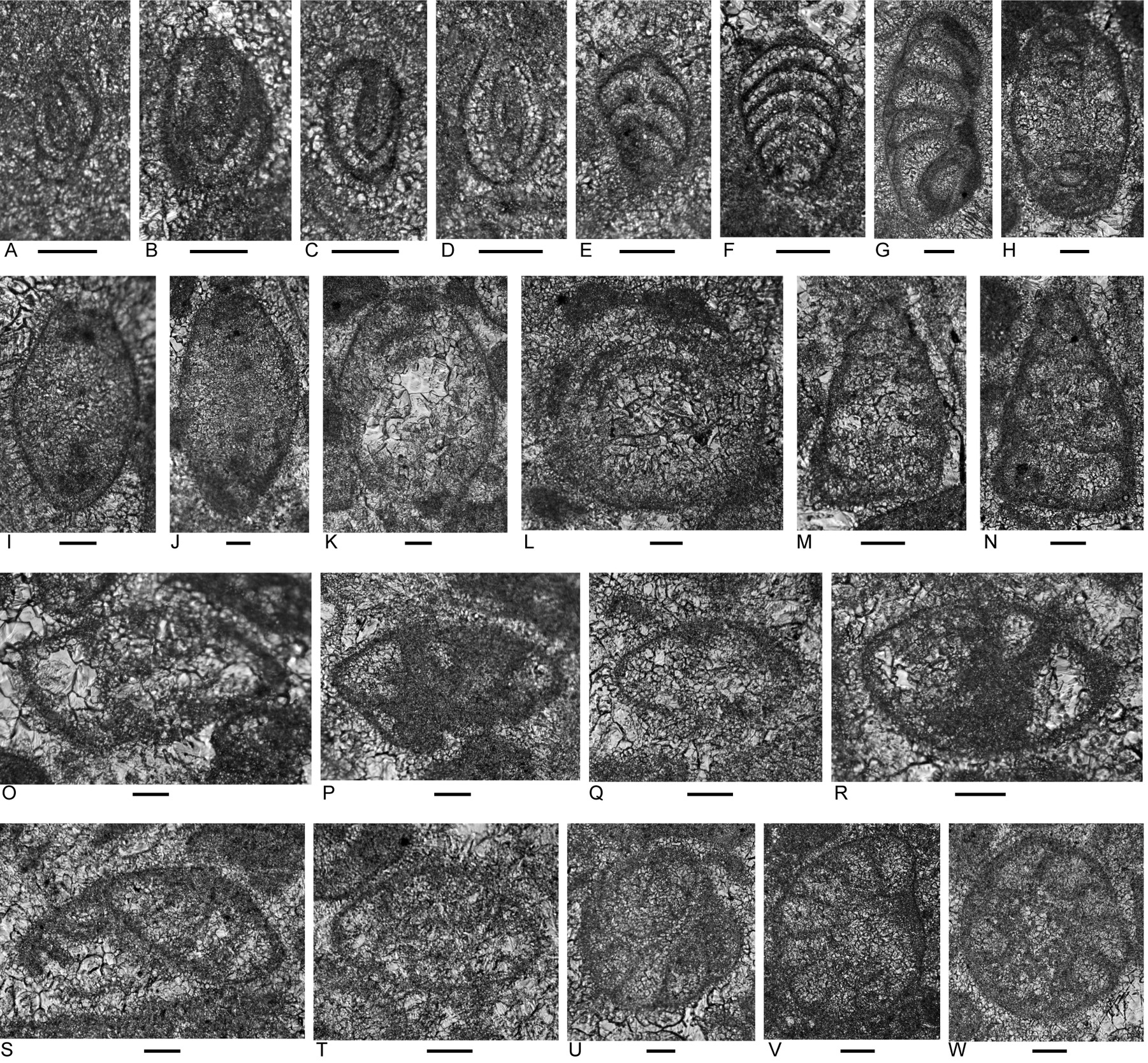
Foraminifers (Figs. 14, 15) are sporadic and rare among the samples. Genera include: carbonate-cemented agglutinated/microgranular ?Duotaxis, Endoteba, Endotebanella, ?Gandinella, Hoyenella, ?Piallina, “Tolypammina”; nodosarians Astacolus and Cryptoseptida; involutinids Aulosina, Aulotortus; and duostominines Cassianopapillaria, Diplotremina and Duostomina.

Age

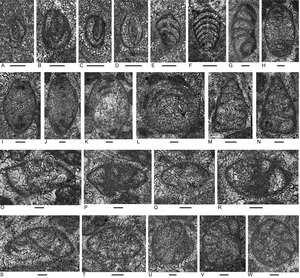
The foraminiferal assemblage includes Aulosina obserhauseri (Fig. 15K, L), Aulotortus communis (Fig. 15H), Diplotremina altoconica (Fig. 15M, N), possible Diplotremina subangulata and indeterminant Cassianopapillariinae that collectively suggest a Norian correlation (see Appendix 5 for ranges and references).

Previous stratigraphic designation and stratigraphic association

Locality 10 is one of several limestone massifs around Tutuala (Wanner 1956; Leme 1963, 1968). From this area, Wanner (1956) noted that “upper Norian” massive coralline limestone is associated with “Carnian” radiolarian-rich limestone. Leme (1963, 1968) noted that the massive grey to light yellow limestone included intraformational conglomerates that contain a Triassic ammonoid, nautiloid and brachiopod assemblage, and that the limestone outcrop contains corals. Leme (1963, 1968) suggested that the coralline limestone at Tutuala and that from Paitchau Range (Fig.10) formed a “reef belt” located at the base of the Triassic succession. Audley-Charles (1968) described highly fossiliferous basal conglomerates of the Aitutu Formation around Tutuala, with an ammonoid assemblage suggesting a Carnian age. Charlton et al. (2009) placed the conglomerates in the Pualaca facies. The Locality 10 limestone at Tutuala belongs within EGIRA, which is consistent with the findings of Wanner (1956, Leme (1963, 1968) and Audley-Charles (1968).
A collage of images of various shapes and sizes AI-generated content may be incorrect.
Figure 14.Foraminifers from the Bandeira Formation in the Tutuala area (Locality 10, Fig. 1). Bar scale = 0.1 mm.

A, B, Indeterminant species with glomospire coiling; A from Sample 175, B from Sample 171. C, Indeterminant, possibly Piallina, from Sample 164. D–G,Tolypammina” spp. (see Pl. 1, Fig. C for discussion on the generic designation); D from Sample 162, E from Sample 163, F from Sample 166, G from Sample 160. H, I, Hoyenella vulgaris (Ho 1959); H from Sample 162, J from Sample 167. J, K, ? Hoyenella spp., from Sample 162. L–S, Micritic tests that show coiling similar to Gandinella kuthani (Salaj, in Salaj et al. 1967) or Gandinella capellinii (Ciarapica and Zaninetti 1984), but may have been diagenetically micritized with some tests showing faint indications of lamellae and perforations suggesting an assignment to Parvalamella spp.; L–N, R–S from Sample 162, O and P from Sample 176, Q from Sample 175. T–Z, Endoteba ex gr. obturata (Brönnimann and Zaninetti 1972) following Vachard et al. (1994); X and V probably belong to the same species; Y and U probably belong to the same species within this group. T and W from Sample 175, U from Sample 167, V from Sample 156, X from Sample 162, Y from Sample 168, Z from Sample 169. ZA, ZB, Endotebanella indeterminant, oblique longitudinal sections that miss the initial coil; ZA from Sample 166, ZB from Sample 170. ZC, ? Duotaxis nanus (Kristan-Tollmann 1964), from Sample 171.

A collage of images of a cell AI-generated content may be incorrect.
Figure 15.Foraminifers from the Bandeira Formation in the Tutuala area (Locality 10, Fig. 1). Bar scale = 0.1 mm.

A–D, indeterminant ophthalmidiids in longitudinal sections; possibly Atsabella sp. if chambered or Agathammina sp. if a coiled tube; A from Sample 155, B from Sample 157, C and D from Sample 158. E, Cryptoseptida sp., from Sample 158. F, Cryptoseptida klebelsbergi Oberhauser 1960, from Sample 166. G, Astacolus cf. hemiselena Kristan-Tollmann 1964, from Sample 156. H, Aulotortus communis (Kristan 1957), from Sample 174. I, J, ? Aulotortus communis (Kristan 1957); I from Sample 171; J from Sample 175. K, L, Aulosina oberhauseri (Koehn-Zaninetti and Brönnimann 1968); K from Sample 175, L from Sample 171. M, N, Diplotremina altoconica Kristan-Tollmann 1973; M from Sample 175, N from Sample 171. O, ? Diplotremina subangulata Kristan-Tollmann 1960; note papillae in umbilical region; from Sample 175. P–S, Cassianopapillaria spp.; P, Q and S from Sample 162, R from Sample 175. T–V, Indeterminant Duostominina; T, U from 162, V from Sample 155. W, Indeterminant Cassianopapillariinae; this is a basal section through papillae in umbilical region; from Sample 162.

DISCUSSION AND CONCLUSIONS

As demonstrated by Haig et al. (2021a; 2025) and Barros et al. (2022, 2025) the Triassic carbonate deposits of Timor-Leste contain distinctive suites of foraminifers that include age-diagnostic species. The shallow-water carbonate-platform facies, defining the Bandeira Formation, has a known stratigraphic range from within the Carnian to within the Rhaetian based on foraminiferal assemblages recorded from nine of the localities described in this paper in eastern Timor-Leste and by Haig et al. (2025) in western Timor-Leste (Fig. 16). Pre-Carnian occurrences of the Bandeira Formation are likely to be found because the cephalopod-rich “Lilu facies” (a submerged platform facies closely associated with the Bandeira Formation in the Upper Triassic, Barros et al. 2022) is known from the earliest Triassic (Berry et al. 1984; McCartain et al. 2024).

At all studied localities, the Bandeira Formation crops out next to exposures of the Babulu and Aitutu formations of the Triassic (middle Anisan to lowermost Rhaetian; McCartain et al. 2024). These units represent basinal mud facies that in some areas contain debris slides with clasts derived from the Bandeira Formation (e.g. Haig et al. 2007). In many of the studied areas, outcrops of the Permian Cribas Group (see Appendix 2) and the Rhaetian to Lower Jurassic Wailuli Formation (Appendix 2) are present close to the Bandeira Formation. It is noteworthy that no debris slides with Bandeira Formation clasts have been found in the Wailuli Formation. This is consistent with the Bandeira carbonate platform not persisting to young parts of the Rhaetian and not extending across the Triassic–Jurassic boundary. Despite the complex deformation, the assembly of stratigraphic units around outcrops of the Bandeira Formation indicates tectonostratigraphic affinity with the East Gondwana Interior Rift Association and is consistent with coeval facies farther south in relatively undeformed basins along the present-day north-western Australian margin. No units equivalent in age to the Bandeira Formation, and no debris slide deposits derived from it have been located within the Overthrust Terranes Association (Nano et al. 2023; Haig et al. 2024).

This contribution to understanding of the Bandeira Formation as well as that by Haig et al. (2025) has set out the distinctive microfacies and foraminifers that allow easy recognition of the formation (particularly in the field with use of a cement-cutting saw and basic inexpensive acetate-peel making equipment as explained in Haig et al. (2021a, 2025). In the past the formation has been confused with other units ranging from Carboniferous–Permian to Miocene, resulting in misleading and naïve tectonostratigraphic interpretations. The challenge now is to more precisely reconstruct the Late Triassic carbonate platform by more detailed facies analyses and more precise correlations.

Figure 16
Figure 16.Chronostratigraphic correlation of Triassic formations belonging to the East Gondwana Interior Rift Association in Timor-Leste.

At the localities 1–4 outlined by Haig et al. (2025) and localities 6–10 described above, the known stratigraphic range of the Bandeira Formation at each locality lies within the grey rectangles in the left-hand column.


ACKNOWLEDGEMENTS

We thank the people and various institutions in Timor-Leste (UNTL, SERN, IPG, IGTL, ANPM, TIMORGAP) for their generosity and hospitality that continues to facilitate our field studies initiated in 2003. We are grateful to our many colleagues in Timor-Leste, Australia, and elsewhere who have contributed to our knowledge of the complex and fascinating geology in this region. We thank Timor Resources for providing logistic support for some of our 2018 field work. Haig thanks the University of Western Australia, and in particular the Oceans Institute that in recent years has provided a stimulating and pleasant base for continuing these studies in retirement. Over the last 15 years this has been a self-funded project. We would like to thank Luka Gale and an anonymous reviewer for their helpful comments on the original 2021 version of the manuscript published in Palaeogeography, Palaeoclimatology, Palaeoecology, and to Barry Taylor and Arthur Mory for commenting on this and the Haig et al. (2025) versions of the originally unpublished supplementary files.

Accepted: December 09, 2025 AWST

References

Audley-Charles, M. G. (1968). The geology of Portuguese Timor. Memoirs of the Geological Society of London, 4, 1–75.
Google Scholar
Banner, F. T., & Highton, J. (1990). On Everticyclammina Redmond (Foraminifera), especially E. kelleri (Henson). Journal of Micropalaeontology, 9, 1–14. https:/​/​doi.org/​10.1144/​jm.9.1.1
Google Scholar
Barros, I. S., Haig, D. W., & McCartain, E. (2022). Uppermost Triassic Halstätt-like cephalopod limestone (Lilu Facies) and Foraminifera, Timor-Leste. Alcheringa: An Australasian Journal of Palaeontology, 46, 244–256. https:/​/​doi.org/​10.1080/​03115518.2022.2112288
Google Scholar
Barros, I. S., Haig, D. W., & McCartain, E. (2025). Upper Triassic (Norian-Rhaetian) variostomatids (Foraminifera), Timor-Leste: Systematics, paleoenvironmental and biostratigraphic implications. Journal of Foraminiferal Research, 55, 188–217. https:/​/​doi.org/​10.61551/​gsjfr.55.2.188
Google Scholar
Berry, R., Burrett, C., & Banks, M. (1984). New Triassic faunas from East Timor and their tectonic significance. Geologica et Palaeontologica, 18, 127–137.
Google Scholar
Brönnimann, P., & Page, C. (1966). Sur quelques Foraminifères du Trias à l’Ouest de Jaun (Canton de Fribourg, Suisse). Archives des Sciences, Genève, 19, 83–91.
Google Scholar
Brönnimann, P., & Whittaker, J. E. (1984). A neotype for Trochammina inflata (Montagu) (Protozoa: Foraminiferida) with notes on the wall structure. Bulletin British Museum of Natural History (Zoology), 46, 311–315.
Google Scholar
Brönnimann, P., & Zaninetti, L. (1972). Foraminifera from the basal Upper Muschelkalk at Hyères, western Basse- Provence, southern France. Rivista Italiana di Paleontologia, 78, 31–64.
Google Scholar
Charlton, T. R., Barber, A. J., McGowan, A. J., Nicoll, R. S., Roniewicz, E., Cook, S. E., Barkham, S. T., & Bird, P. R. (2009). The Triassic of Timor: Lithostratigraphy, chronostratigraphy and palaeogeography. Journal of Asian Earth Sciences, 36, 341–363. https:/​/​doi.org/​10.1016/​j.jseaes.2009.06.004
Google Scholar
Ciarapica, G., & Zaninetti, L. (1984). Foraminifères et biostratigraphie dans le Trias supérieur de la série de la Spezia (Dolomies de Coregna et Formation de la Spezia, nouvelles formations), Apennin septentrional. Revue de Paléobiologie, 3, 117–134.
Google Scholar
de Castro, P. (1990). Studies on the Triassic carbonates of the Salerno province (Southern Italy): the Croci d’Acerno sequence. Bollettino della Società Geologica Italiana, 109, 187–217.
Google Scholar
Di Bari, D., & Rettori, R. (1996). Morphological features of Triasina hantkeni Majzon 1954 (Foraminifera, Aulotortidae) and remarks on the test wall structure. Revue de Micropaléontologie, 39, 305–313. https:/​/​doi.org/​10.1016/​S0035-1598(96)90146-4
Google Scholar
Falzoni, F., Rettori, R., Gale, L., Mikhalevich, V. I., Weinmann, A. E., & Parente, M. (2025). Taxonomy and palaeoecology of the Mesozoic family Duotaxidae Mikhalevich (Foraminifera). Papers in Palaeontology, 11(5), e70032. https:/​/​doi.org/​10.1002/​spp2.70032
Google Scholar
Fugagnoli, A. (2000). First record of Everticyclammina Redmond 1964 (E. praevirguliana n. sp.; Foraminifera) from the Early Jurassic of the Venetian Prealps (Calcari Crigi, Trento Platform, northern Italy). Journal of Foraminiferal Research, 30, 126–134. https:/​/​doi.org/​10.2113/​0300126
Google Scholar
Gageonnet, R., & Lemoine, M. (1958). Contribution à la connaissance de la géologie de la province Portugaise de Timor. Estudos, Ensaios e Documentos Ministério do Ultramar Junta de Investigações do Ultramar, 48, 7–134.
Google Scholar
Gale, L., Korat, L., Marinšek, M., & Grădinaru, E. (2022). Use of X-ray micro-computed tomography on selected Upper Triassic (Rhaetian) foraminifera from the western Black Sea shelf, offshore Romania. Rivista Italiana di Paleontologia e Stratigrafia, 128, 267–282.
Google Scholar
Grady, A. E., & Berry, R. F. (1977). Some Palaeozoic-Mesozoic stratigraphic-structural relationships in East Timor and their significance in the tectonics of Timor. Journal of the Geological Society of Australia, 24, 203–214. https:/​/​doi.org/​10.1080/​00167617708728981
Google Scholar
Grunau, H. R. (1953). Geologie von Portugiesisch Osttimor. Eclogae geologicae Helvetiae, 46, 29–37.
Google Scholar
Grunau, H. R. (1957). Geologia da parte oriental do Timor Português. Nota abreviada. Garcia de Orta, 5, 727–737.
Google Scholar
Haig, D., Rigaud, S., McCartain, E., Martini, R., Barros, I. S., Brisbout, L., Soares, J., & Nano, J. (2025). Triassic massive limestones forming high peaks and mountain ranges in Timor: part 1: western Timor- Leste. Journal of The Royal Society of Western Australia, 108. https:/​/​doi.org/​10.70880/​001c.143801
Google Scholar
Haig, D. W., & McCartain, E. (2007). Carbonate pelagites in the post-Gondwana succession (Cretaceous–Neogene) of East Timor. Australian Journal of Earth Sciences, 54, 875–897. https:/​/​doi.org/​10.1080/​08120090701392739
Google Scholar
Haig, D. W., McCartain, E., Barber, L., & Backhouse, J. (2007). Triassic–Lower Jurassic foraminiferal indices for Bahaman-type carbonate-bank limestones, Cablac Mountain, East Timor. Journal of Foraminiferal Research, 37, 248–264. https:/​/​doi.org/​10.2113/​gsjfr.37.3.248
Google Scholar
Haig, D. W., Nano, J., Fraga, E., Soares, M., Barros, I. S., McCartain, E., & Baillie, P. (2024). Disjunct Lower Jurassic to lowest Miocene stratigraphic units in the Matebian Overthrust Terrane, Timor-Leste, northwestern margin of Australian continent. Journal of the Royal Society of Western Australia, 107, 36–61. https:/​/​doi.org/​10.70880/​001c.126413
Google Scholar
Haig, D. W., Rigaud, S., McCartain, E., Martini, R., Barros, I. S., Brisbout, L., Soares, J., & Nano, J. (2021). Upper Triassic carbonate-platform facies, Timor-Leste: Foraminiferal indices and tectonostratigraphic association. Palaeogeography, Palaeoclimatology, Palaeoecology, 570, Article 110362. https:/​/​doi.org/​10.1016/​j.palaeo.2021.110362
Google Scholar
Haig, D. W., Rigaud, S., McCartain, E., Nano, J., Barros, I. S., & Martini, R. (2021). Biostratigraphic indices for Lower Jurassic carbonate-platform deposits (Perdido Group), Overthrust Terrane Association, Timor-Leste. Journal of Asian Earth Sciences, 215, Article 104797. https:/​/​doi.org/​10.1016/​j.jseaes.2021.104797
Google Scholar
He, Y. (1982). Some Mesozoic foraminifera from Xizang. In Nanjing Institute of Geology and Paleontology (Ed.), Paleontology of Xizang, Book 4 (pp. 33–46). Scientific Publishing House.
Google Scholar
Hirschi, H. (1907). Zur Geologie und Geographie von Portugiesisch-Timor. Neues Jahrbuch for Mineralogie, Geologie und Paleontologie, 24, 460–474.
Google Scholar
Ho Y. (1959). Triassic Foraminifera from the Chialingkiang Limestone of South Szechuan [in Chinese and English]. Acta Palaeontologica Sinica, 7, 387–418.
Google Scholar
Koehn-Zaninetti, L. (1969). Les Foraminifères du Trias de la région de l’Almtal (Haute-Autriche). Jahrbuch Geologisch Bundesanstalt, Wien, 14, 1–155.
Google Scholar
Koehn-Zaninetti, L., & Brönnimann, P. (1968). Triasina oberhauseri, n. sp., un Foraminifère nouveau de la Dolomie principale des Alpes Calcaires septentrionales (Autriche). Publication de l’Institut de Paléontologie de Genève, 1–8. https:/​/​archive-ouverte.unige.ch/​unige:165143
Google Scholar
Kristan, E. (1957). Ophthalmidiidae und Tetrataxinae (Foraminifera) aus dem Rhät der Hohen Wand in Nieder- Österreich. Jahrbuch der Geologischen Bundesanstalt, 100, 269–298.
Google Scholar
Kristan-Tollmann, E. (1960). Rotaliidea (Foraminifera) aus der Trias der Ostalpen. Jahrbuch der Geologischen Bundesanstalt Sonderband, 5, 47–78.
Google Scholar
Kristan-Tollmann, E. (1962). Stratigraphisch wertvolle Foraminiferen aus Obertrias- und Liaskalken der voralpinen Fazies bei Wien. Erdoel-Zeitschrift, 78, 228–233.
Google Scholar
Kristan-Tollmann, E. (1964). Die Foraminiferen aus den rhätischen Zlambachmergeln der Fischerwiese bei Ausse im Salzkammergut. Jahrbuch der Geologischen Bundesanstalt, Sonderband, 10, 1–189.
Google Scholar
Kristan-Tollmann, E. (1973). Neue sandschalige Foraminiferen aus der alpinen Obertrias. Neues Jahrbuch für Geologie und Paläontologie Monatshefte, 1973, 416–428.
Google Scholar
Krumbeck, L. (1921). Die Brachiopoden, Lamellibranchiaten und Gastropoden der Trias von Timor. Paläontologie von Timor, 17, 1–142.
Google Scholar
Leme, J., & Azeredi, de. (1968). Breve ensaio sobre a geologia da Province de Timor. Junta de Investigações do Ultramar. Curso de Geologia do Ultramar (Lisboa), 1, 107–161.
Google Scholar
Leme, J. de A. (1963). The eastern end geology of Portuguese Timor (A preliminary report). Garcia do Orta (Lisboa), 11, 379–388.
Google Scholar
Majzon, L. (1954). Contributions to the stratigraphy of the Dachstein Limestone. Acta Geologica, Academiae Scientiarum Hungaricae, 2, 243–249.
Google Scholar
Martini, R., Vachard, D., & Zaninetti, L. (1995). Pilammina sulawesiana, n. sp. (Ammodiscidae, Pilammininae, n. subfam.), a new foraminifer from Upper Triassic reefal facies in E Sulawesi (Kolonodale area, Indonesia). Revue de Paléobiologie, 14, 455–460.
Google Scholar
Martini, R., Zaninetti, L., Lathuillière, B., Cirilli, S., Cornée, J.-J., & Villeneuve, M. (2004). Upper Triassic carbonate deposits of Seram (Indonesia): palaeogeographic and geodynamic implications. Palaeogeography, Palaeoclimatology, Palaeoecology, 206, 75–102. https:/​/​doi.org/​10.1016/​j.palaeo.2003.12.020
Google Scholar
McCartain, E., Orchard, M. J., Mantle, D., Haig, D. W., Bertinelli, A., Chiari, M., Ferreira, F. S., dos Santos, Z., Backhouse, J., Taylor, B. A., Barros, I. S., Araujo, B. N., Araujo, A. de, Boavida, N., Peyrot, D., & Rigo, M. (2024). Applying integrated Triassic biostratigraphy in Timor-Leste to unlock the under sampled Gondwana sector of the Tethys puzzle. Journal of Asian Earth Sciences, 265, Article 106052. https:/​/​doi.org/​10.1016/​j.jseaes.2024.106052
Google Scholar
Nano, J., Haig, D. W., Fraga, E., Soares, M., Barros, I. S., McCartain, E., & Baillie, P. (2023). Debris-slides, olistoliths and turbidites: keys to understanding the tectonostratigraphic affinities of a terrane block in a young orogenic belt, Timor-Leste. Journal of the Geological Society, London, 181, jgs2023079.
Google Scholar
Nogami, Y. (1963). Fusulinids from Portuguese Timor. Palaeontological Study of Portuguese Timor.
Google Scholar
Nogami, Y. (1968). Trias-Conodonten von Timor, Malaysien und Japan (Palaeontological Study of Portuguese Timor, 5). Memoirs of the Faculty of Science, Kyoto University, Series of Geology and Mineralogy, 34, 115–136.
Google Scholar
Oberhauser, R. (1960). Foraminiferen und Mikrofossilien “incertae sedis” de ladinischen und karnischen Stufe de Trias aus den Ostalpen und aus Persien. Jahrbuch der Geologischen Bundesanstalt, 5, 5–46.
Google Scholar
Parker, W. K., & Jones, T. R. (1859). On the nomenclature of the Foraminifera, Part 2. On the species enumerated by Walker and Montagu. Annals and Magazine of Natural History, 3(4), 333–351.
Google Scholar
Piller, W. (1978). Involutinacea (foraminifera) des Trias und des Lias. Beiträge zur Paläontologie Österreich, 5, 1–164.
Google Scholar
Redmond, C. D. (1964). Lituolid Foraminifera from the Jurassic and Cretaceous of Saudi Arabia. Micropaleontology, 10, 251–263. https:/​/​doi.org/​10.2307/​1484643
Google Scholar
Rigaud, S., Martini, R., & Rettori, R. (2013). A new genus of Norian involutinid foraminifers: Its morphological, biostratigraphic, and evolutionary significance. Acta Palaeontologica Polonica, 58, 391–405.
Google Scholar
Salaj, J. (1969). Quelques remarques sur les problèmes microbiostratigraphiques du Trias. Notes du Service Géologique Tunisie, Tunis, 31, 5–23.
Google Scholar
Salaj, J., Biely, A., & Bystrický, J. (1967). Trias-Foraminiferen in den Westkarpaten. Geologické Práce, Zpravy, 42, 119–136.
Google Scholar
Salaj, J., Borza, K., & Samuel, O. (1983). Triassic foraminifers of the West Carpathians. Geologický Ústav Dionýza Stúra.
Google Scholar
Timor. (n.d.). Memoirs of the College of Science, University of Kyoto, Series B. 30, 59–68.
Google Scholar
Urosevic, D. (1981). Some new species from the Triassic of East Serbia (The Carpatho — Balkanides). Société Serbe de Géologie Communications, 56, 113–118.
Google Scholar
Vachard, D., Martini, R., Rettori, R., & Zaninetti, L. (1994). Nouvelle classification des foraminifères endothroïdes du Trias. Geobios, 27, 543–557. https:/​/​doi.org/​10.1016/​S0016-6995(94)80249-1
Google Scholar
Vinassa de Regny, P. (1915). VIII. Triadische Algen, Spongien, Anthozoean und Bryozoen aus Timor. Paläontologie von Timor IV, Lieferung, Stuttgart, 75–118.
Google Scholar
Wanner, J. (1956). Zur Stratigraphie von Portugiesisch Timor. Zeitschrift der Deutchen Geologischen Gesellschaft, 108, 109–139.
Google Scholar
Weynschenk, R. (1956). Some rare Jurassic index foraminifera. Micropaleontology, 2, 283–286. https:/​/​doi.org/​10.2307/​1484182
Google Scholar
Yamagiwa, N. (1963). Some Triassic corals from Portuguese Timor, palaeontological study of Portuguese Timor (1). Memoirs of Osaka University, Liberal Arts and Education, B (Natural Science), 12, 83–86.
Google Scholar

APPENDIX 1

Grey literature

Benincasa, A. (2015). The ‘fatus’ of East Timor: stratigraphy and structure. PhD thesis, The University of Western Australia, Perth. https://research-repository.uwa.edu.au/en/publications/the-fatus-of-east-timor-stratigraphy-and-structure/

McCartain, E., 2014. Stratigraphic studies on Timor-Leste: Part A, Reassessment of mechanisms that drove development of the Triassic succession, Timor-Leste: with a focus on the Babulu Group; Part B, Co-authored papers on other aspects of Timor stratigraphy. PhD Thesis, The University of Western Australia. 439 pp. https://research-repository.uwa.edu.au/en/publications/stratigraphic-studies-on-timor-leste/

Geotechnik Pty Ltd, 2006. Cl, Iralalaru Hydropower Project BH # 1, boring log, 22 November 2006, Report ET06-5037. Minerals and Energy Policy, Timor Leste. Available from Instituto de Geosciências de Timor-Leste, Dili, Timor-Leste.

Norwegian Water Resources and Energy Directorate (NVE), 2006. Final Report, Iralalaru Hydropower Project - Feasibility Study. Ministry of Natural Resources, Minerals and Energy Policy, Timor Leste. Available from Instituto de Geosciências de Timor-Leste, Dili, Timor-Leste.

SUPPLEMENTARY MATERIALS

APPENDIX 2: Updated stratigraphic framework for Timor Leste (Compiled by David W. Haig and Isaias Santos Barros, November 2025). Appendix_2.docx

APPENDIX 3: Details of studied samples. Appendix_3.xlsx

APPENDIX 4: Distribution of grain types and Foraminifera in studied Bandeira Formation samples. Appendix_4.xlsx

APPENDIX 5: Known stratigraphic ranges, in sections considered reliable outside of the East Gondwana Interior Rift, of age-diagnostic foraminiferal species found at the studied localities. (Compiled by Sylvain Rigaud and David W. Haig, January 2021) Appendix_5.pdf